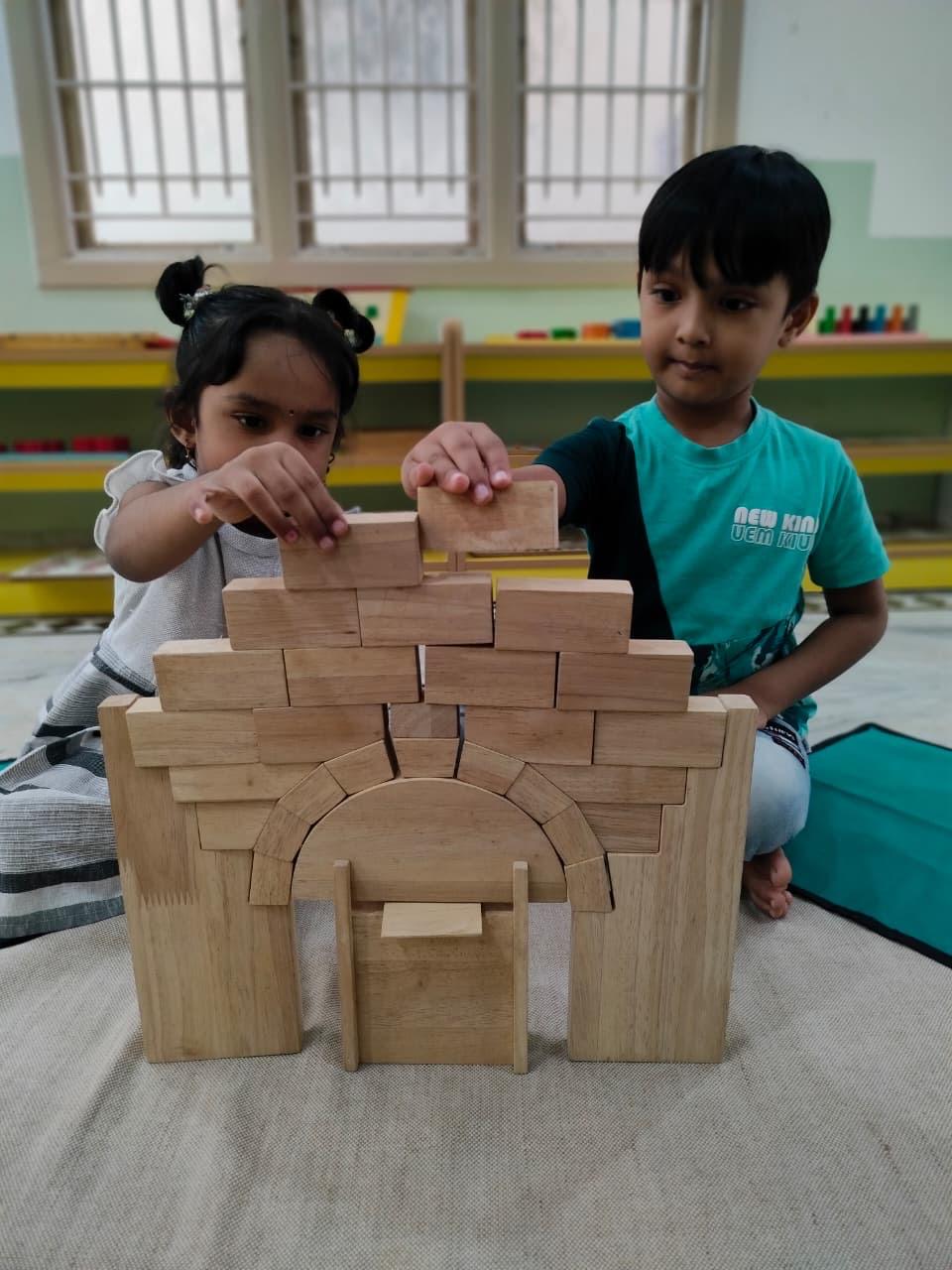
Pre-Schools in Guntur are more than simply the sandbox these days. Schools in Guntur also get more challenging than elementary school does. To prepare for elementary school, preschoolers are expected to acquire several abilities. Where does play fit in, given the constrained time in a pre-school setting and the pressure for achievement later on?
Children are naturally playful. Their earliest sensory explorations inspire them to play, initially by themselves and then gradually with others. Play is a requirement in the National Association for the Education of Young Children's accreditation process for early childhood programs. "When they're having fun while learning and playing, that's when it's a good experience. They adopt a constructive mindset toward learning." Says the experts.
Children's play becomes more complex as they grow. A child plays alone and interacts with others very little until they are two years old. He soon begins to observe other kids playing but may not join in. When older preschoolers are playing nearby, children in mixed-age environments can observe and learn from younger children and will find this very useful.
The development of play is crucially dependent on the preschool teacher. Parents should check to see if the teacher has set up the atmosphere appropriately and is utilizing her curriculum to help her prepare how the kids will engage in play, advises Pizzolongo. It truly is an organized method of education. Simply put, it appears to have a different structure than the one you could encounter in fourth grade.
The different play styles for kids can be categorized, although they frequently cross over.
Children learn skills via play that they will use in school.
Play promotes the development of both gross and fine motor skills. Children playing outside will push themselves to take on new challenges and develop their motor skills if they feel safe and supported. Children can practice using their hands and fingers by handling small objects to develop their fine motor skills, which in turn helps them develop the strength and coordination necessary for writing.
When you're a preschooler or toddler, your attention comes out differently. As many areas of your body as possible must be engaged for your attention to be adequate. Children are thus taught to play in which they are physically involved with objects and engage in social interaction.
Through cooperative play, kids develop their language skills. Their capacity for and patience with self-explanation are critical factors in their success. Children's words are repeated by teachers so that others can understand them. Additionally, they impart vocabulary related to the items the kids are curious about handling.
While playing with other kids, students may chat to themselves before repeating what they hear or talking to each other. By age 4, this evolves into a back-and-forth play-related conversation that is increasingly complex. Children will now make rules, assign roles, voice their preferences or complaints, and converse about fun events during play.
A strong sense of self-confidence develops via play. It takes a lot of effort for a preschooler to try a particular trick on a play structure or construct something out of blocks. Teachers celebrate these occasions by describing what they see and giving preschoolers another chance to take in their accomplishments.
All youngsters can benefit from the play's therapeutic qualities. For instance, a play scenario can be used to reinforce the idea that a parent will go to work and return for pick-up.
For 4- and 5-year-olds, listening, negotiating, and compromising is difficult. Working with others enables youngsters to become more conscious of the diversity among others around them, even though they are still egocentric or unable to look beyond their own needs at this young age.
These pre-schools in Guntur experiences lay the groundwork for learning how to resolve conflicts and interact with peers. Children who naturally want to lead but need to learn impulse control can develop positive leadership skills through play.
When you visit pre schools in Guntur you are thinking about, find out their approach to play. Preschoolers require playtime, prepared areas for exploration, and responsive teachers to assist their academic development. Children who grow up in such an environment are not only better students who will collaborate with others and approach learning with delight but also happier people who will never lose their love of play.
1. Why is play important in preschool education?
Play helps children develop physical, social, emotional, and cognitive skills, making learning fun and effective.
2. What types of play activities are included in preschools?
Preschools include dramatic play, physical activities, creative play, and manipulative tasks like puzzles and building blocks.
3. How does play improve a child’s language development?
Through interaction and communication during play, children learn new vocabulary, improve speaking skills, and build confidence.
4. What role do teachers play in play-based learning?
Teachers guide, observe, and structure play activities to support learning while encouraging creativity and exploration.
5. How can parents evaluate play-based learning in a preschool?
Parents should check for dedicated play areas, balanced schedules, trained teachers, and a curriculum that integrates play with learning.